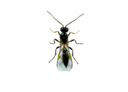
General The onion thrips (Thrips tabaci) is distributed throughout the world. It is found outdoors on many plants and particularly damaging on onions, leek, and in greenhouses on cucurbits, tomato, sw
thrips are dark brown with the apex of the abdomen paler; females are 1.4-1.7 mm long and males are 1.1-1.2 mm long. The legs are entirely white or yellow
General Impatiens thrips (Echinothrips americanus) is an increasing problem in greenhouse cultivation, having spread to many countries within the last 30 years. The thrips have mostly been able to spr
can sometimes be seen in the daytime. Eggs are laid singly or in groups of 5 to 10 eggs, overlapping in a tile-like fashion on both the upper and lower [...] on the stem or stalk close to the ground. The pinkish red eggs are about 0.5 mm in diameter and become steadily darker. Just before hatching, which occurs
moth The female box tree moth ( Cydalima perspectalis ) deposits clusters of 5 to 20 eggs in a translucent gelatinous mass on the leaves of box trees. The
prothoracic shield, later they become earth-brown to dingy grey. They are about 1.5 mm long just after emergence and can reach 4 cm or more when fully grown. The
yellowish brown or light brown with a darker head. Larval development takes 4 to 5 years. When fully grown the larvae pupate in the soil in summer. The adults
General The chafers are beetles of the Scarabaeidae family. The larvae of both species live in the soil and feed on the roots of many plants. They are a serious pest that can cause substantial damage.
General The cotton aphid ( Aphis gossypii ) is an extremely polyphagous aphid found on more than 700 plant species. Crop plants attacked by this aphid include cotton, citrus, coffee, cocoa, eggplant,